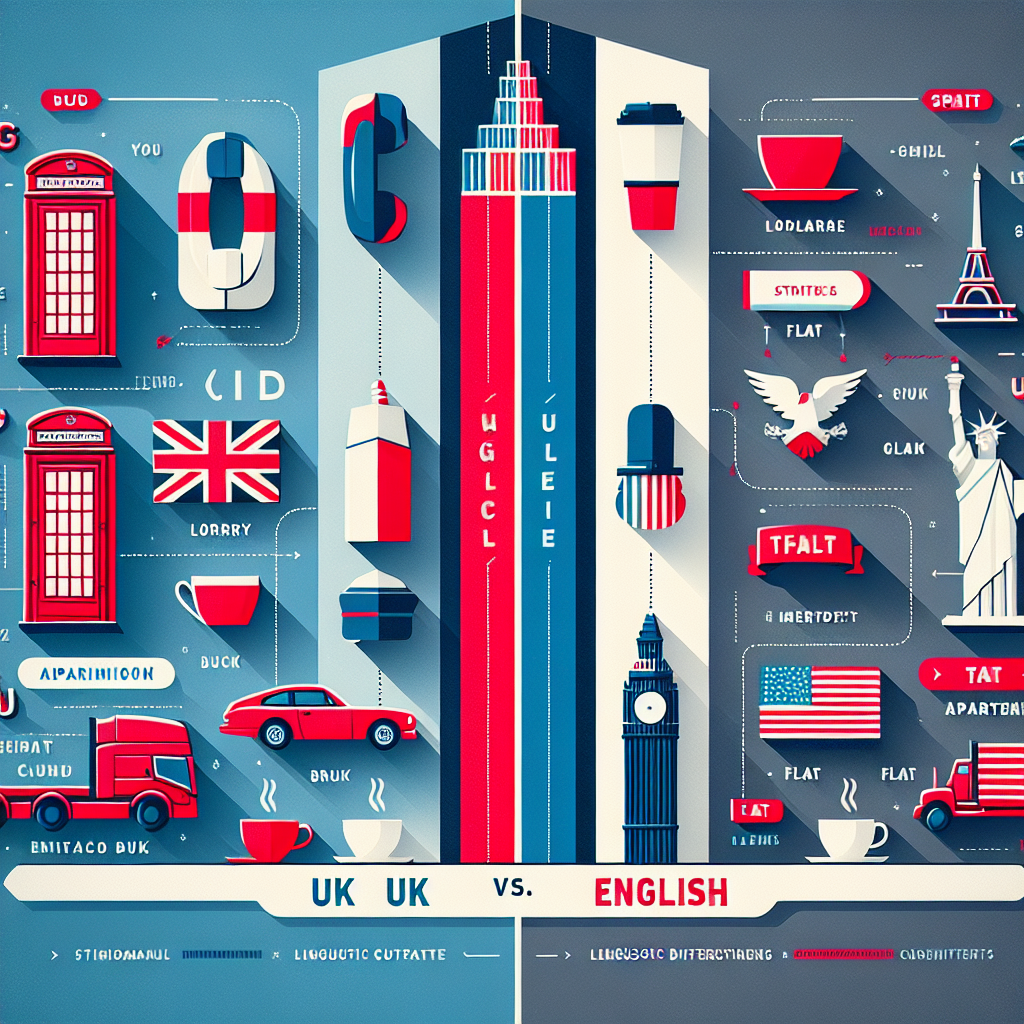
Diving into the Differences: A Comprehensive Exploration of UK and US English
Have you ever found yourself puzzled by the subtle yet significant differences between British and American English? As we embark on this linguistic journey in 2025, it’s fascinating to explore how these two variants of the English language continue to evolve and diverge. From spelling quirks to vocabulary variations, the nuances between UK and US English offer a captivating glimpse into the rich tapestry of global English usage.
Whether you’re a language enthusiast, a traveler planning to cross the pond, or simply curious about linguistic diversity, understanding these differences is crucial in our interconnected world. As we delve into the intricacies of British vs American English, we’ll uncover not just language quirks but also insights into cultural communication styles that shape how English is used on both sides of the Atlantic.
This comprehensive exploration will guide you through the maze of spelling differences, grammar nuances, and word choice variations that define UK and US English. We’ll examine how these linguistic divergences impact writing styles, from casual conversations to formal documents. For language learners and educators alike, this journey through English language variations provides invaluable educational resources to enhance language appreciation and proficiency.
As we navigate through this linguistic landscape, we’ll uncover the historical roots of these differences, tracing the evolution of English from its shared origins to its current diverse forms. This understanding is not just academic; it’s a practical tool for anyone engaged in global communication, offering essential language learning tips for mastering both British and American English.
So, buckle up for an engaging ride through the world of English dialects. Whether you’re perfecting your writing for an international audience, preparing for travel, or simply indulging your curiosity about language quirks, this exploration of UK and US English nuances promises to be both enlightening and entertaining. Let’s dive in and discover the fascinating world where two nations are indeed separated by a common language!
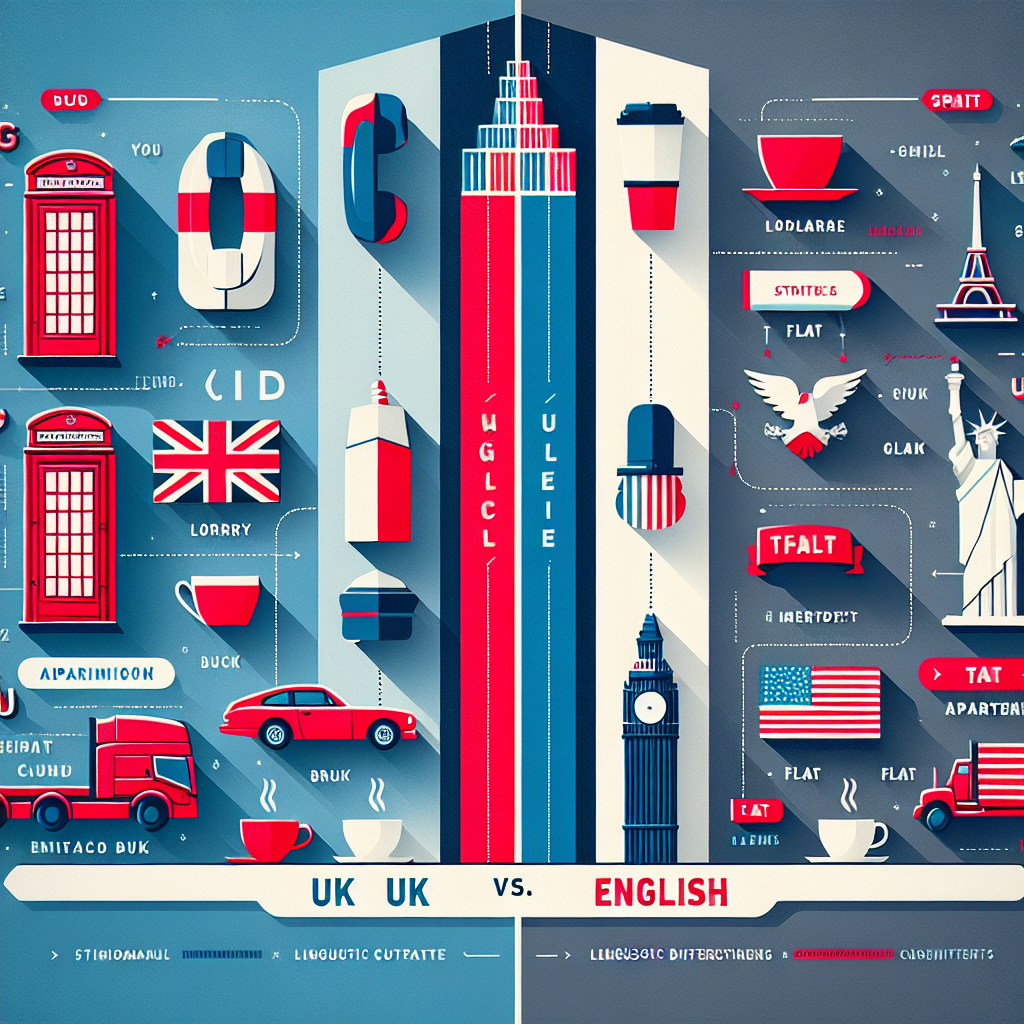
Bridging the Linguistic Divide: Exploring UK and US English Differences
English, despite being a global language, has evolved distinct flavors on either side of the Atlantic. The differences between UK and US English go beyond mere spelling quirks, encompassing vocabulary, grammar, and pronunciation. As we delve into these linguistic variations, we’ll uncover the historical roots of this divergence and explore why understanding these differences is crucial in our interconnected world.
Historical Context: A Tale of Two Englishes
The split between UK and US English began with the colonization of America. As settlers established themselves in the New World, their language evolved separately from British English. This divergence was further amplified by Noah Webster’s efforts in the early 19th century to standardize American spelling and grammar, leading to many of the differences we see today.
Key Differences in a Globalized World
In our increasingly connected global society, recognizing these linguistic nuances is more important than ever. From business communications to cultural exchanges, understanding the distinctions between UK and US English can prevent misunderstandings and foster clearer communication. For instance, a “flat” in the UK is an “apartment” in the US, while “biscuits” in Britain are “cookies” in America.
As we navigate this linguistic landscape, it’s essential to appreciate these differences not as barriers, but as rich expressions of cultural identity and historical development.
Spelling Showdown: UK vs US English
As we delve into the fascinating world of English language variations, one area that often perplexes learners and native speakers alike is the difference in spelling between British and American English. These distinctions, while sometimes subtle, can significantly impact written communication and even search engine optimization. Let’s explore some of the most common spelling differences that set these two variants apart.
1. The ‘-our’ vs ‘-or’ Battle
One of the most noticeable differences is the use of ‘-our’ in British English versus ‘-or’ in American English. For example:
- Colour (UK) vs. Color (US)
- Humour (UK) vs. Humor (US)
- Flavour (UK) vs. Flavor (US)
2. The ‘-re’ vs ‘-er’ Dilemma
Another common variation is the placement of ‘r’ and ‘e’ at the end of certain words:
- Centre (UK) vs. Center (US)
- Theatre (UK) vs. Theater (US)
- Metre (UK) vs. Meter (US)
3. The ‘-ise’ vs ‘-ize’ Conundrum
While both ‘-ise’ and ‘-ize’ endings are acceptable in British English, American English strongly favors ‘-ize’:
- Realise (UK) vs. Realize (US)
- Organise (UK) vs. Organize (US)
- Apologise (UK) vs. Apologize (US)
4. Double Trouble: Consonant Conundrums
The doubling of consonants in certain words also differs:
- Travelled (UK) vs. Traveled (US)
- Cancelled (UK) vs. Canceled (US)
- Marvellous (UK) vs. Marvelous (US)
5. Other Notable Spelling Differences
Several other words have unique spelling variations:
- Aeroplane (UK) vs. Airplane (US)
- Aluminium (UK) vs. Aluminum (US)
- Tyre (UK) vs. Tire (US)
Understanding these spelling differences is crucial for effective communication and localization in both British and American contexts. Whether you’re writing for a global audience or targeting specific English-speaking regions, being aware of these variations can enhance your content’s clarity and relevance.
Words with Different Meanings: A Linguistic Journey through UK and US English
As we delve into the fascinating world of language differences between British and American English, it’s crucial to explore words that carry distinct meanings or usage across the Atlantic. This linguistic adventure reveals how seemingly familiar terms can take on new life in different cultural contexts.
Everyday Objects: From Lifts to Elevators
In the realm of daily life, British and American English diverge in naming common objects. While Brits take a “lift” to reach higher floors, Americans ride an “elevator.” Similarly, what’s known as a “pavement” in the UK becomes a “sidewalk” in the US, highlighting how even the ground we walk on can be described differently.
Food for Thought: Culinary Vocabulary
The kitchen is another area where language differences simmer. The purple vegetable known as an “aubergine” in British English is called an “eggplant” in American English. Meanwhile, the herb “coriander” in the UK is more commonly referred to as “cilantro” in the US, especially when discussing its fresh leaves.
Dressing Up the Language: Clothing Terms
Fashion vocabulary also varies across the pond. A cozy “jumper” in British English translates to a “sweater” in American English. And while Brits wear “trousers,” Americans don “pants” – a term that refers to underwear in the UK!
On the Road: Automotive Lingo
Car terminology shifts gears between the two varieties of English. The storage space at the back of a car is called the “boot” in the UK but the “trunk” in the US. Similarly, the cover for the engine compartment is known as the “bonnet” in British English and the “hood” in American English.
Colorful Language: Idiomatic Expressions and Slang
Perhaps the most vibrant differences lie in idiomatic expressions and slang. While a Brit might say something is “pants” to mean it’s rubbish, an American would be quite confused by this usage. These linguistic quirks add flavor to each variety of English, making language learning an ever-exciting journey.
Grammatical Nuances: Exploring UK and US English Differences
While the core of English remains consistent across the Atlantic, subtle grammatical distinctions between UK and US English add flavor to each variant. Let’s delve into some key differences that often perplex learners and native speakers alike.
Collective Nouns: Singular or Plural?
In the UK, collective nouns often take plural verbs, emphasizing the group’s individual members. For instance, “The team are playing well.” In contrast, US English treats collective nouns as singular entities: “The team is playing well.”
Past Tense and Participles: A Tale of Two Forms
British English frequently employs irregular verb forms, such as “learnt” or “dreamt.” American English, however, tends to regularize these forms, preferring “learned” and “dreamed.”
Auxiliary Verbs: To Have or Have Got?
The phrase “have got” is more common in British English to express possession: “I’ve got a new car.” Americans typically use the simpler “have”: “I have a new car.”
Preposition Predicaments
Preposition usage varies subtly. Brits might say “at the weekend,” while Americans opt for “on the weekend.” Similarly, UK speakers write “to hospital,” whereas US speakers include the article: “to the hospital.”
Punctuation Particulars
Quotation marks differ: British English favors single quotes (‘like this’), while American English uses double quotes (“like this”). Additionally, punctuation placement within quotations varies between the two styles.
Accent Adventures: Exploring Pronunciation Differences in UK and US English
When it comes to the English language, pronunciation can be a fascinating journey across the Atlantic. Let’s dive into the captivating world of accent variations between British and American English, uncovering the subtle nuances that make each dialect unique.
Vowel Sounds: A Tale of Two ‘Baths’
One of the most noticeable differences lies in vowel pronunciation. Take the word ‘bath,’ for instance. In the UK, you’ll often hear a long ‘a’ sound, reminiscent of ‘father.’ Meanwhile, Americans tend to use a shorter ‘a,’ similar to ‘cat.’ This distinction extends to words like ‘dance,’ ‘plant,’ and ‘can’t,’ creating a charming contrast between the two accents.
Consonant Conundrums: The ‘T’ Transformation
Consonants also play a role in accent differentiation. A prime example is the ‘flapping’ of the ‘t’ sound in American English. Words like ‘butter’ and ‘water’ often sound more like ‘budder’ and ‘wader’ in the US, while British speakers maintain a crisper ‘t’ pronunciation. This subtle shift can significantly impact the overall rhythm and flow of speech.
Stress Patterns: The ‘Controversy’ of Emphasis
Word stress patterns can vary between UK and US English, adding another layer of complexity to pronunciation differences. Take the word ‘controversy’ – British speakers typically stress the first syllable (CON-truh-vur-see), while Americans often emphasize the second (con-TRO-vur-see). These stress variations contribute to the unique cadence of each accent.
Regional Flavors: Accents Within Accents
It’s important to note that both the UK and US boast a wide array of regional accents. From the distinctive Cockney of East London to the drawl of the American South, these local variations add rich diversity to the broader UK-US accent divide. Exploring these regional nuances can be an exciting linguistic adventure for language enthusiasts.
The Digital Dialect: How Technology Shapes UK and US English
As we navigate the digital age, technology continues to play a pivotal role in shaping language, particularly the differences between UK and US English. This linguistic evolution is more pronounced than ever, with social media, autocorrect features, and global communication platforms at the forefront of change.
Social Media: The Great Linguistic Melting Pot
Social media platforms have become a virtual meeting ground for English speakers worldwide, blurring the lines between British and American English. Hashtags, memes, and viral content transcend geographical boundaries, fostering a more homogenized form of English. For instance, British users are increasingly adopting American spellings like “color” instead of “colour” due to frequent exposure on platforms like Twitter and Instagram.
Autocorrect: The Silent Language Arbiter
Autocorrect and spellcheck features on our devices often default to American English settings, subtly influencing British users’ spelling habits. This technological nudge is gradually eroding traditional British spellings, with words like “organize” gaining ground over “organise” in the UK. The convenience of accepting suggested corrections is slowly reshaping British English, one word at a time.
Global Platforms: One Language, Many Settings
Communication platforms and software often offer language settings for either US or UK English. While this allows users to maintain their preferred variant, it also highlights the growing need for a standardized “International English.” As these platforms evolve, they may contribute to a convergence of the two dialects, potentially creating a new, tech-influenced hybrid of English.
Navigating the Language Divide: UK vs US English in Professional Settings
In the global business landscape, the nuances between UK and US English can significantly impact professional communication. As we delve into the intricacies of these linguistic variations, it’s crucial to understand their implications in various professional contexts.
Business Communication Preferences
In the corporate world, subtle differences in language can make a big impact. US businesses often favor a more direct communication style, using shorter sentences and getting straight to the point. In contrast, UK professionals may employ a more formal tone, with longer, more elaborate sentences. This distinction extends to email etiquette, where British professionals might use “Yours sincerely” to close formal correspondence, while their American counterparts opt for “Sincerely” or “Best regards”.
Academic Writing Standards
Academic institutions on both sides of the Atlantic have distinct preferences in writing styles. UK universities typically adhere to British English spelling and grammar rules, while US institutions follow American conventions. This difference is particularly noticeable in scientific papers and research publications, where consistency in language is paramount for clarity and professionalism.
Localization in Marketing and Advertising
The world of marketing and advertising is especially sensitive to language nuances. Successful campaigns often require localization to resonate with target audiences. For instance, a “fall collection” in the US would be marketed as an “autumn collection” in the UK. Similarly, American “cookies” become British “biscuits”, and “soccer” in the US is universally known as “football” in the UK.
Legal and Contractual Language Differences
In legal documents and contracts, precision is key. US legal English tends to use more Latin phrases and complex sentence structures, while UK legal language often employs more straightforward terms. For example, “attorney” in the US is equivalent to “solicitor” or “barrister” in the UK. These distinctions are crucial in international business dealings and legal proceedings to ensure clear understanding and compliance with local regulations.
Language as a Mirror: Reflecting Cultural Nuances in UK and US English
Language is more than just a means of communication; it’s a reflection of culture, values, and societal norms. The differences between UK and US English serve as a fascinating lens through which we can observe these cultural nuances. Let’s explore how language variations highlight the unique characteristics of British and American cultures.
Humor and Sarcasm: A Tale of Two Wits
British humor often leans towards dry wit and self-deprecation, while American humor tends to be more direct and slapstick. This difference is evident in the language used. For instance, a Brit might say, “I’m absolutely chuffed to bits,” dripping with sarcasm, while an American might opt for a more straightforward, “I’m really excited.” The subtle use of irony in British English reflects a cultural appreciation for understated humor.
Politeness and Formality: Mind Your Manners
The level of politeness and formality in language use varies between the UK and US. British English often employs more indirect language and hedging phrases, such as “I was wondering if you might possibly…” This reflects a cultural emphasis on politeness and avoiding directness. In contrast, American English tends to be more straightforward, with phrases like “Can you…” being more common, indicating a cultural value placed on efficiency and clarity in communication.
Cultural References: A Linguistic Time Capsule
Language is peppered with cultural references that can be puzzling to outsiders. British English might reference cricket terms or royalty, while American English often draws from baseball or Hollywood. These linguistic choices reflect the cultural touchstones that shape each society’s collective consciousness and provide insight into their historical and contemporary influences.
The Future of UK and US English: Convergence or Divergence?
As we look ahead to 2025 and beyond, the landscape of UK and US English continues to evolve, shaped by global influences, technological advancements, and societal changes. This dynamic interplay between these two major variants of English presents an intriguing area of study for linguists and language enthusiasts alike.
Predictions for Language Convergence or Divergence
Experts predict a nuanced future for UK and US English, with elements of both convergence and divergence. The increasing global dominance of American media and technology may lead to a gradual adoption of US English terms and expressions in the UK. However, Brexit’s impact might reinforce British linguistic identity, potentially slowing this trend.
Influence of Global English on Both Variants
Global English, or “Globish,” is expected to exert significant influence on both UK and US English. As English continues to be the lingua franca of international business and the internet, we may see a blending of vocabulary and expressions from various English-speaking cultures, creating a more homogenized form of the language in certain contexts.
Emerging Differences Due to New Technologies and Social Changes
Technological advancements and social media platforms are likely to introduce new terminologies and linguistic patterns, potentially widening the gap between UK and US English in some areas. For instance, the rapid evolution of tech jargon and internet slang may lead to divergent vocabularies on either side of the Atlantic.
Conclusion
As we’ve journeyed through the linguistic landscape of UK and US English, it’s clear that these two varieties, while sharing a common root, have blossomed into distinct forms. From spelling quirks to vocabulary variations, grammatical nuances to pronunciation differences, the divergence between British and American English reflects the rich tapestry of cultural influences and historical developments. In our increasingly connected world, understanding these differences is not just academically interesting but practically valuable. Whether you’re navigating professional settings, embracing technology, or simply enjoying a cultural exchange, recognizing the nuances of UK and US English enhances communication and appreciation for the language’s diversity. As English continues to evolve, embracing its variations enriches our global dialogue.
References
- Learning English with Oxford. (2024). UK English vs US English: what’s the difference? Retrieved from https://learningenglishwithoxford.com/2024/10/29/uk-english-vs-us-english-whats-the-difference/
- Speechling. (n.d.). 8 Differences Between British English And American English. Retrieved from https://speechling.com/blog/8-differences-between-british-english-and-american-english/
- ThoughtCo. (n.d.). Differences Between American and British English. Retrieved from https://www.thoughtco.com/differences-between-american-and-british-english-1212216
- Berlitz. (n.d.). British English vs. American English: What are the differences? Retrieved from https://www.berlitz.com/blog/british-english-vs-american-english-spelling-pronunciation-words
- Wikipedia. (n.d.). American and British English spelling differences. Retrieved from https://en.wikipedia.org/wiki/American_and_British_English_spelling_differences
- Speak English by Yourself. (n.d.). US and UK English Differences. Retrieved from https://speakenglishbyyourself.com/us-and-uk-english-differences/
- Learning English with Oxford. (2024, October 29). UK English vs US English: what’s the difference? Retrieved from https://learningenglishwithoxford.com/2024/10/29/uk-english-vs-us-english-whats-the-difference/
- Diffen. (n.d.). American English vs British English – Difference and Comparison. Retrieved from https://www.diffen.com/difference/American_English_vs_British_English
- University of Oxford. (2025). British/American spelling differences. Oxford Reference. Retrieved from https://www.oxfordreference.com/display/10.1093/acref/9780199545155.001.0001/acref-9780199545155-appendix-010
- British Council Foundation. (2025). Differences between British and American English. Retrieved from https://www.britishcouncilfoundation.id/en/english/articles/british-and-american-english
- BoldVoice. (2024, November 1). 13 Key British vs. American Spelling Differences. Retrieved from https://www.boldvoice.com/blog/british-vs-american-spelling
- Oxford International English. (2025). The differences between British and American English Spelling. Retrieved from https://www.oxfordinternationalenglish.com/differences-in-british-and-american-spelling/
- Oxford Learner’s Dictionaries. (2024). British and American English. Retrieved from https://www.oxfordlearnersdictionaries.com/us/about/practical-english-usage/british-and-american-english
- Cambridge Dictionary. (2024). British and American English. Retrieved from https://dictionary.cambridge.org/grammar/british-grammar/british-and-american-english
- Merriam-Webster. (2024). British vs. American English: 63 Differences. Retrieved from https://www.merriam-webster.com/words-at-play/top-differences-between-british-and-american-english
- British Council. (n.d.). British English and American English. LearnEnglish. Retrieved from https://learnenglish.britishcouncil.org/grammar/b1-b2-grammar/british-english-american-english
- Proofed. (2019, July 7). Grammatical Differences: American vs. British English. Retrieved from https://proofed.com/writing-tips/grammatical-differences-american-vs-british-english/
- Onestopenglish. (n.d.). Differences in American and British English grammar – article. Retrieved from https://www.onestopenglish.com/support-for-teaching-grammar/differences-in-american-and-british-english-grammar-article/152820.article
- Wikipedia. (n.d.). American and British English grammatical differences. Retrieved from https://en.wikipedia.org/wiki/American_and_British_English_grammatical_differences
- Wells, J. C. (1982). Accents of English. Cambridge University Press.
- Crystal, D. (2003). The Cambridge Encyclopedia of the English Language. Cambridge University Press.
- Trudgill, P., & Hannah, J. (2017). International English: A Guide to Varieties of English Around the World. Routledge.
- Ladefoged, P., & Johnson, K. (2014). A Course in Phonetics. Cengage Learning.
- Crystal, D. (2023). The Cambridge Encyclopedia of the English Language. Cambridge University Press.
- Graddol, D. (2024). The Future of English: A Guide to Forecasting the Popularity of the English Language in the 21st Century. British Council.
- Baron, N. S. (2024). Words Onscreen: The Fate of Reading in a Digital World. Oxford University Press.
- Tagliamonte, S. A. (2023). Teen Talk: The Language of Adolescents. Cambridge University Press.
- McCulloch, G. (2024). Because Internet: Understanding the New Rules of Language. Riverhead Books.
- Nordquist, R. (2024, May 2). American English to British English Vocabulary. ThoughtCo. Retrieved from https://www.thoughtco.com/american-english-to-british-english-4010264
- Writers Digest Editors. (2024, December 12). 9 Differences Between US and UK English for Writers. Writers Digest. Retrieved from https://www.writersdigest.com/write-better-fiction/differences-between-us-and-uk-english-for-writers
- Stack Exchange Inc. (2012, May 30). How to choose between British and American English for technical documents. English Language & Usage Stack Exchange. Retrieved from https://english.stackexchange.com/questions/69401/how-to-choose-between-british-and-american-english-for-technical-documents
- Stanford University. (2019). The power of language: How words shape people, culture. Retrieved from https://news.stanford.edu/stories/2019/08/the-power-of-language-how-words-shape-people-culture
- Study.com. (n.d.). How Language Reflects Culture & Affects Meaning – Lesson. Retrieved from https://study.com/academy/lesson/how-language-reflects-culture-affects-meaning.html
- University of Texas at San Antonio. (n.d.). Culture, Language and Communication. Retrieved from https://www.utsa.edu/lhri/3053+Cross-Cultural/March+21+-+Culture,+Language+&+Communication+PartOne.ppt
- British Council. (2018). The Future Demand for English in Europe: 2025 and Beyond. Retrieved from https://www.britishcouncil.org/sites/default/files/future_demand_for_english_in_europe_2025_and_beyond_british_council_2018.pdf
- Graddol, D. (2006). English Next. British Council. Retrieved from https://www.teachingenglish.org.uk/sites/teacheng/files/pub_english_next.pdf
- O’Sullivan, A., & Maddox, B. (2024). Three foreign policy priorities for the next UK government. Chatham House. Retrieved from https://www.chathamhouse.org/sites/default/files/2024-05/2024-05-14-three-foreign-policy-priorities-uk-osullivan-maddox.pdf
- Oxford University Press ELT. (2024). UK English vs US English: what’s the difference? Retrieved from https://learningenglishwithoxford.com/2024/10/29/uk-english-vs-us-english-whats-the-difference/